What Can CNC Machines Make for a Kit Car Build?
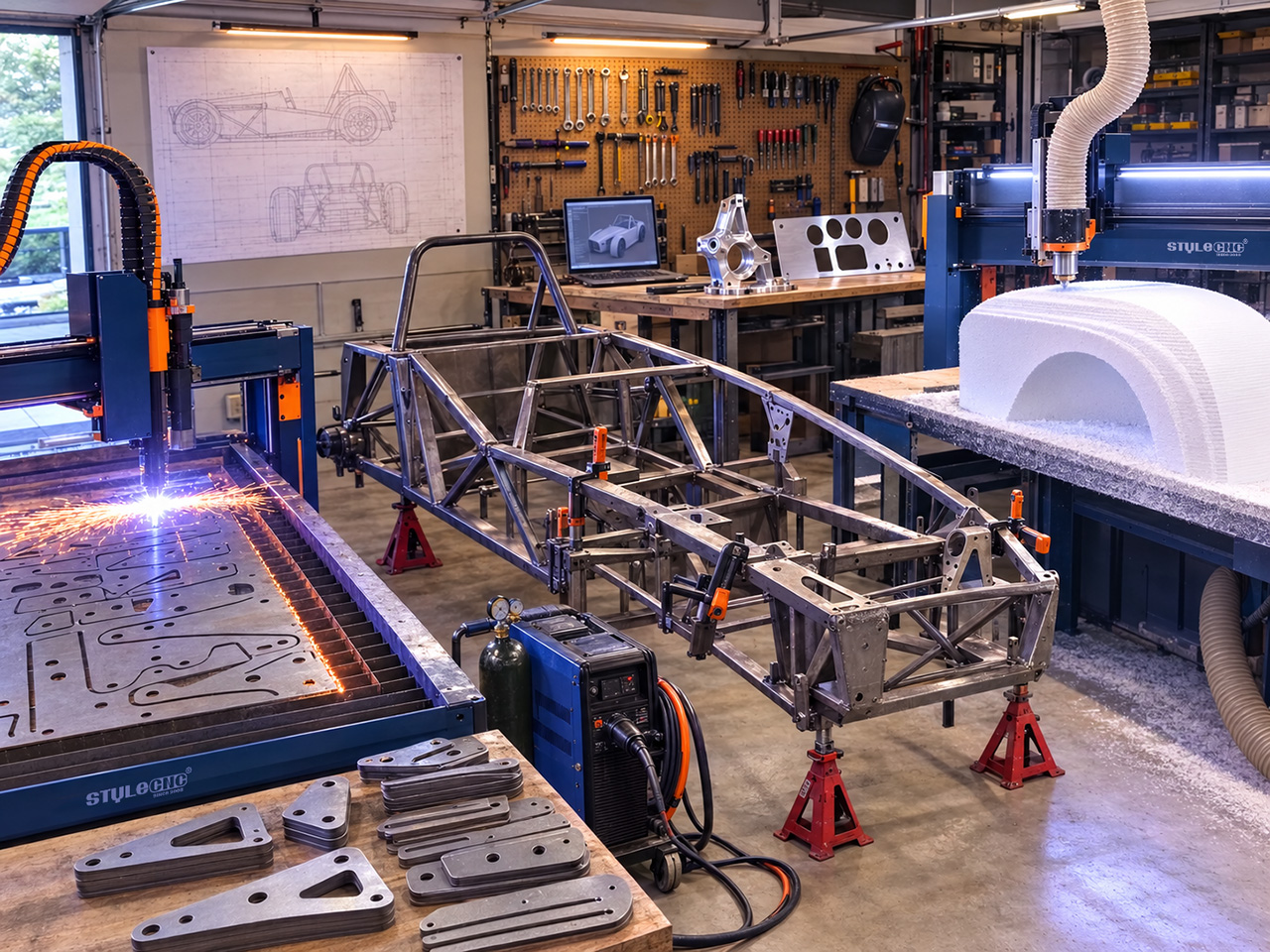
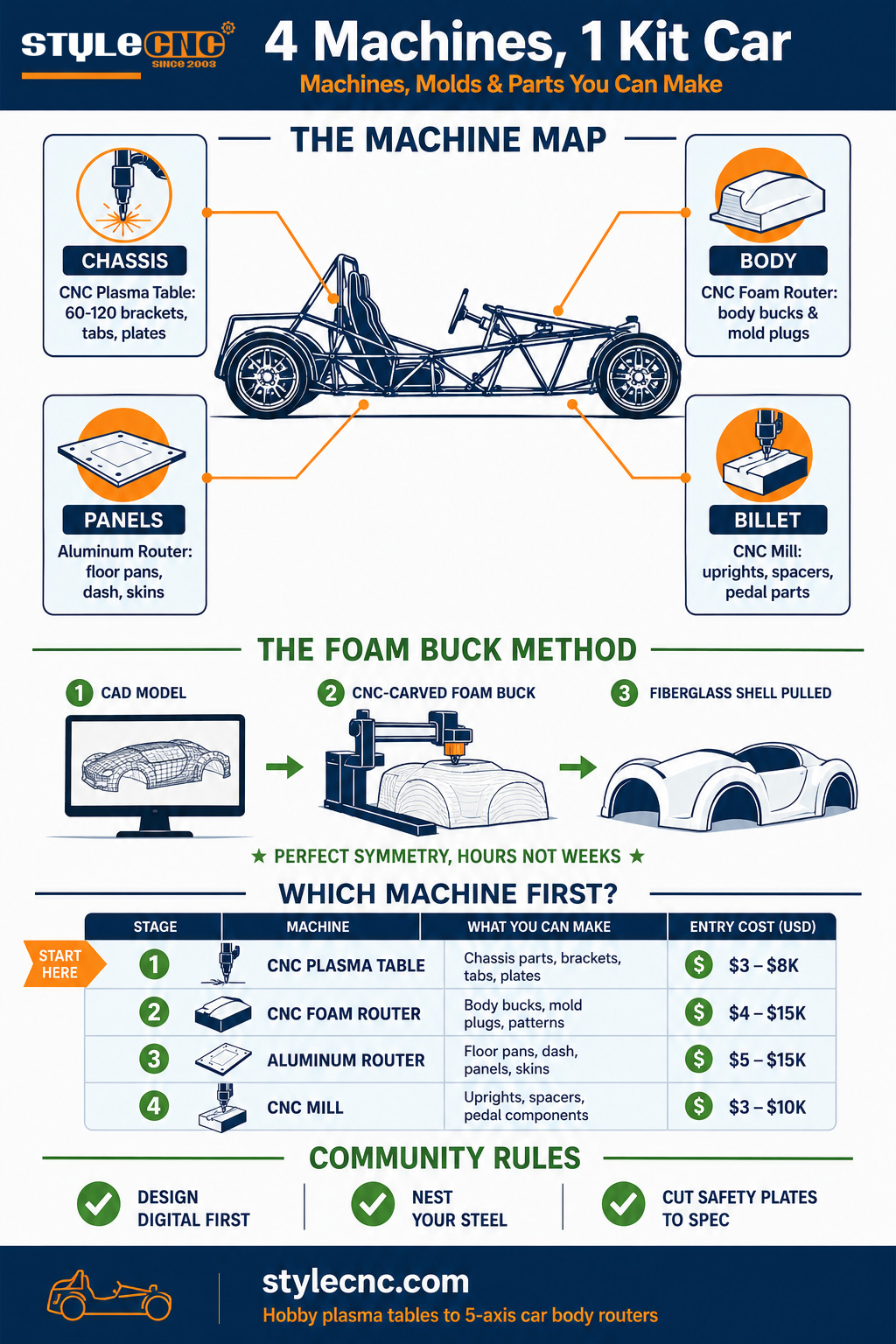
CNC machines cover 4 kit car jobs: a CNC plasma table cuts chassis brackets, tabs, and reinforcement plates from steel; a CNC foam router carves full-size body bucks and mold plugs; a Δρομολογητής CNC cuts dash panels, floor pans, and interior parts; and a CNC mill machines billet suspension and engine components. Builders typically start with a plasma table.
Kit car building is really 4 fabrication disciplines wearing one hood: steel chassis work, composite bodywork, panel fitting, and precision mechanical parts. Each discipline maps cleanly to one CNC machine type, and none of them requires industrial equipment. Everything below fits a 2-car garage.
The community proof is everywhere. LocostUSA forum members cut chassis plates and brackets on CNC plasma tables built or bought specifically for their car projects, with one builder noting that cutting brackets and tabs on the machine is far easier and faster than angle grinders and jigsaws. Others fabricate glass-foam-glass body structures over CNC-shaped bucks. The machines have become part of the hobby rather than a shortcut around it.
The Chassis: CNC Plasma for Brackets, Tabs, and Plates
MACHINE 1: CNC Plasma Cutting Table
The workhorse of a scratch-built chassis. A Locost-style space frame needs dozens of steel brackets, suspension tabs, engine mount plates, and reinforcement gussets, and every one of them is a flat 2D profile that a plasma table cuts from 3 to 6 mm mild steel in seconds. Roll cage mounting feet alone illustrate the precision case: motorsport rules commonly require reinforcement plates of at least 3 mm thickness and a minimum area, welded to the shell with specific bolt patterns. Cutting those to drawing on a CNC table beats hand-grinding every time.
The workflow mirrors the sign-shop and metal-art pipelines: draw the bracket in CAD (or download community DXF files, which the Locost world shares freely for book-chassis plates), nest the parts on a sheet, and cut. One LocostUSA member with laser and CNC access offered exactly this to the community: send drawings, receive finished chassis plates, no minimum order. With your own table, that service lives in your garage.
A 4x4 τραπέζι πλάσματος CNC για χόμπι covers the bracket-and-tab work of a full chassis build, and the larger CNC plasma cutting tables add capacity for floor pans, firewall blanks, and transmission tunnel panels cut from full sheets. Builders who finish their car often keep the table earning as a side business, the exact path covered in the plasma metal art business guide.
If your business requires higher cutting precision for metal automotive parts, a ίνα λέιζερ μηχάνημα κοπής είναι μια καλύτερη επιλογή.
The Body: CNC Foam Bucks and Mold Plugs
MACHINE 2: CNC Foam Router (3-Axis to 5-Axis)
The single biggest CNC upgrade to kit car building. Traditional fiberglass bodywork starts with a hand-shaped buck: weeks of shaping, sanding, and eyeballing symmetry. A CNC foam router carves the same buck from EPS or polyurethane foam blocks directly from the 3D model, perfectly symmetric, in hours. Lay fiberglass over the buck, pull the shell, and the body matches the CAD. LocostUSA builders describe the standard method precisely: the foam serves only as a temporary buck to glass over, then the glass comes off and the foam's job is done.
This is where the digital thread pays off hardest. Nose cones, fenders, scuttles, and full body shells can be modeled once, mirrored for perfect left-right symmetry, and cut in sections that glue into a full-size plug. Design changes cost a re-cut, not a restart. For one-off bodywork, builders glass directly over the buck. For repeatable parts, the buck becomes the plug for a proper fiberglass mold.
The STYLECNC foam machining applications gallery shows this class of work, and the Κόφτης αφρού CNC 4 αξόνων handles rotary carving for wheel arch sections and compound curves. At the top end, the same process scales to full production: STYLECNC 5-axis routers carve complete car body bucks for automotive prototyping, και το 3D foam cutting for car mold making video shows a full-scale mold buck being machined, the industrial version of exactly what a garage builder does at kit scale.
Panels and Billet: The Router and the Mill
MACHINE 3: Δρομολογητής CNC (Aluminum-Capable)
The panel shop. Aluminum floor pans, transmission tunnel covers, dash panels with gauge cutouts, seat mounting plates, and interior trim all come off a gantry router cutting aluminum sheet and composite panel. The Locost tradition rivets aluminum skins to the frame roughly every inch, and a router cuts every skin, every lightening hole, and every rivet-line reference mark to the drawing. Dash panels alone justify the machine for many builders: gauge holes, switch cutouts, and engraved labels in one setup.
MACHINE 4: CNC Mill (Hobby to Full Size)
The precision parts department. Suspension uprights, brake caliper brackets, steering rack spacers, pedal assemblies, engine mount interfaces, and shifter components are billet aluminum territory: parts that carry load, need real tolerances, and bolt to machined surfaces. A hobby-class metal mill handles most of it in 6061-T6, with 7075-T6 reserved for the genuinely high-stress pieces. Builders on Locost forums model entire suspension systems in CAD before cutting a single part, which means every bracket already exists as a machinable file.
For the billet work, the χόμπι φρέζα CNC για μέταλλο covers the bracket-and-spacer class of parts, and the material fundamentals (billet versus cast, 6061 versus 7075, feeds and speeds) are covered in the billet aluminum machining guide. For panel work, the Δρομολογητής CNC for aluminum setup guide details the spindle, tooling, and hold-down requirements.
Which Machine First? The Build-Stage Table
Few builders buy all 4 machines. The right 1st machine depends on which stage of the build consumes your hours, and what you already outsource. The table maps machine to build stage, typical parts count, and entry cost.
| Στάδιο κατασκευής | Μηχανή | Τυπικά εξαρτήματα | Κόστος εισόδου (USD) |
|---|---|---|---|
| Chassis fabrication | Τραπέζι πλάσματος CNC | 60 to 120 brackets, tabs, plates, gussets | από 3,000 έως 8,000 |
| Bodywork and molds | Δρομολογητής αφρού CNC | 1 buck or plug set (nose, fenders, scuttle) | από 4,000 έως 15,000 |
| Panels and interior | Aluminum-capable router | 15 to 30 skins, pans, dash panels | από 5,000 έως 15,000 |
| Billet components | Hobby CNC mill | 10 to 25 machined parts | από 3,000 έως 10,000 |
For most scratch builders, the plasma table wins the first-purchase decision: the chassis has the highest part count, the parts are simple 2D profiles, and the community precedent is deepest. Builders starting from a purchased frame kit skip to the foam router or mill depending on whether bodywork or mechanical customization is the bigger ambition.
3 practical notes from the build community:
✓ Design digital first: Locost builders increasingly model the full chassis and suspension in CAD before cutting anything. Every bracket you model is a cut file you already own, and shared community models give you a head start.
✓ Nest your steel: A chassis-worth of brackets nests onto a few sheets. Cutting them in one session beats making parts one at a time for months, and the nesting habit carries straight from the plasma and ACP workflows.
✓ Mind the rules: If the car will ever see competition, cut safety-structure plates to the sanctioning body's specification from the start. Reinforcement plate thickness, area, and bolt count are written into motorsport manuals, and CNC-cut parts document compliance far better than hand-made ones.
Συχνές ερωτήσεις
Can you really CNC cut a kit car chassis?
The brackets, tabs, plates, and gussets, yes; the tube frame itself is still cut, notched, and welded by hand. LocostUSA members run CNC plasma tables specifically for chassis plate work, and community members with CNC access have offered cut-to-drawing chassis plate services with no minimum order. The frame tubes remain a welding project, which is most of the fun anyway.
How do builders make kit car body molds with CNC?
The standard method carves a buck from EPS or polyurethane foam on a Δρομολογητής CNC, directly from the 3D body model. Fiberglass is laid over the buck, cured, and pulled, and as LocostUSA builders describe it, the foam serves only as a temporary shape to glass over. For repeatable parts, that 1st pull becomes the plug for a production mold. CNC cutting makes the buck perfectly symmetric, which hand shaping never quite achieves.
Where do kit car DXF files and plans come from?
The Locost world is built on shared plans: the original Ron Champion book chassis, community-refined 3D models on forums like LocostUSA, and builder-shared bracket DXF libraries. Many builders model their own suspension in CAD (Inventor, Fusion 360, AutoCAD are all common in build logs) and generate cut files from those models. Any 2D bracket drawing becomes a plasma or router cut file in minutes.
What CNC machine should a kit car builder buy first?
For a scratch build, the plasma table: the chassis needs the most CNC-cut parts (60 to 120 brackets and plates), entry tables start around $3,000, and the machine keeps earning after the build cutting art, signs, and parts for other builders. For a frame-kit build where bodywork is the project, a foam-capable router takes the 1st slot instead.
Can a hobby CNC mill make suspension parts?
Load-bearing brackets, spacers, caliper adapters, and pedal components in 6061-T6 billet, yes, within the rigidity limits of the machine and with sensible engineering margins. Safety-critical geometry deserves proper analysis regardless of who machines it; the Locost community norm is to model the full suspension in CAD, which puts every part one CAM step from the mill. Reserve 7075-T6 for the genuinely high-stress pieces.
Η κατώτατη γραμμή
A kit car build is 4 fabrication projects, and CNC now has a machine for each: plasma for the chassis steel, foam carving for the body buck, an aluminum router for the panels, and a mill for the billet parts. None of it removes the craft. It removes the grinding, the asymmetric bodywork, and the months of one-bracket-at-a-time fabrication that stall most projects before paint.
STYLECNC builds garage-scale versions of every machine in this guide, from hobby plasma tables μέσω foam cutting routers και metal-capable mills, μέχρι το 5-axis systems that carve full car bodies for automotive prototyping. Contact the STYLECNC team with your build plan and the parts list you want to stop outsourcing.